
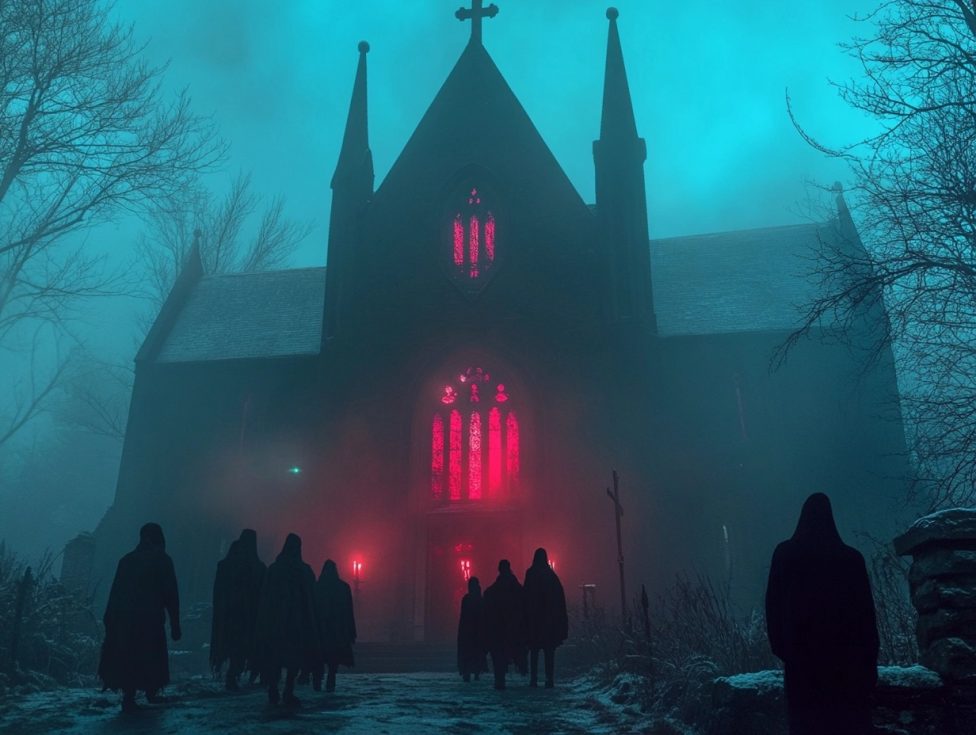
When Midnight Mass dropped on Netflix, horror fans and casual viewers alike found themselves unexpectedly grappling with deep questions of faith, guilt, and redemption—all through the lens of a remote island community besieged by a supernatural twist. On the surface, it was a vampire-ish horror show. But beneath the jump-scares and eerie atmosphere, the series offered a potent examination of how religion can be wielded—or warped—by fear, zealotry, and the longing for salvation. For many, Midnight Mass felt less like simple entertainment and more like a haunting reflection of our collective religious nightmares. The show’s enduring impact raises a broader question: Why does horror, of all genres, so often serve as a compelling mirror to religious tension and fanaticism?
Horror and Religion: A Longstanding Relationship
Historically, horror stories have been prime spaces to explore spiritual dread—from demonic possession tales (The Exorcist) to gothic church imagery in Hammer films. Religiously-inflected horror digs into core anxieties: the existence of evil, the fragility of human faith, and the fear that we might be misled by false prophets or malevolent forces masquerading as divine. In Midnight Mass, these themes converge in a microcosm: an isolated island parish where the lines between miracle and monstrosity blur.
This backdrop resonates because religion often deals in absolutes—good vs. evil, salvation vs. damnation. Horror thrives on conflict, especially moral or existential conflict. Blend them, and you get potent storytelling that questions whether faith is our shield or our downfall.
The Plot: A Brief Refresher (Spoilers Ahead)
Set on Crockett Island—a decaying fishing village with dwindling hope—Midnight Mass follows the return of Riley Flynn, a local who served a prison term for a drunk-driving accident. Soon after, a mysterious young priest, Father Paul, arrives to fill in for the aging Monsignor. Strange occurrences unfold: the crippled walk, the sick recover, but also bizarre deaths plague the town. The priest, it turns out, has made a diabolical bargain with an “angel” (actually a vampiric creature), believing its miraculous blood can restore faith and immortality.
As the “miracles” escalate, fervor grips the parish. But the town’s holy rejuvenation conceals a nightmarish transformation, culminating in an apocalyptic confrontation. In the end, the show exposes how a devout community’s yearning for salvation and fear of death can be twisted into a literal bloodbath.
Catholic Guilt, Zeal, and Redemption Arcs
Midnight Mass creator Mike Flanagan weaves his own Catholic upbringing into the narrative, using the show to dissect Catholic guilt and the promise of forgiveness. Characters wrestle with personal sins: Riley’s manslaughter, the mayor’s denial about his daughter’s wheelchair-bound future, Father Paul’s hidden shame about his love for a parishioner. Each sees the “angel’s” blood as a path to rectify regrets.
In a broader sense, this dynamic underscores how religion can offer absolution but also how easily desperation can lead believers astray. Father Paul’s monologues about resurrection and second chances feel earnest—he genuinely sees the creature as an angel and thinks he’s leading his flock toward God’s grace. The horror arises when that sincerity dovetails with self-deception, unleashing something monstrous in the name of faith.
A Reflection on Cultish Devotion
At its core, Midnight Mass critiques cultish devotion. The devout Bev Keane, for instance, takes religious zeal to chilling extremes—weaponizing Scripture to justify violence, silencing dissent by labeling critics as faithless. She’s a stand-in for any extremist who uses dogma to bully others into compliance. Her moral certainty, combined with Father Paul’s misguided leadership, catalyzes the community’s downfall.
Horror here acts as an amplifying lens: it exaggerates the real-world phenomenon where communities can be manipulated by charismatic leaders. The vampirism is symbolic of toxic religious fervor—once you “drink the blood,” you’re reborn, but you’ve also lost your humanity. This metaphor parallels how groupthink or blind faith can erode critical thinking and empathy, turning the faithful into unrecognizable monsters to outsiders—and eventually to themselves.
The Island Setting: Isolation Breeds Belief
Crockett Island itself becomes a microcosm of religious isolation. Cut off from the mainland, lacking outside voices, the townsfolk rely heavily on the church for guidance and communal identity. This dynamic echoes real-life scenarios where insular religious sects flourish away from broader societal checks. Midnight Mass shows how a tight-knit, struggling community can be particularly susceptible to promises of miraculous renewal.
Isolation fosters an “us vs. them” mentality: conspiracies and group loyalty intensify. Horror thrives in such claustrophobic environments—nowhere to run, no external help. This setting magnifies the show’s tension: if the entire community succumbs to the “angel’s” thrall, no rescue is coming, and the few dissenters are trapped among the devout.
Horror Unmasks Religious Themes
Why does horror so effectively dissect religious themes? Because fear—the primal engine of horror—lies at the heart of many religious experiences: fear of sin, fear of damnation, fear that you might be wrong. Midnight Mass channels that tension, showing how the desire to conquer death (arguably the ultimate human fear) can open the door to spiritual exploitation.
Moreover, horror’s willingness to depict the grotesque or morally disturbing allows us to confront taboos we often avoid in polite religious discourse: blood rituals, end-time scenarios, manipulative clergy. The show’s graphic vampiric communion is a nightmarish parallel to the sacred Eucharist—an inversion that questions how literal or figurative certain rituals might be if taken to extremes.
Faith vs. Fanaticism
One strength of Midnight Mass is its empathy for faith itself. Not every believer is portrayed as gullible or evil. Characters like the Muslim sheriff grapple with their own beliefs in a predominantly Christian setting, highlighting interfaith tensions. Others, like the mild-mannered doctor or Annie Flynn (Riley’s mother), maintain a loving, humanistic version of faith that rejects Bev’s fanaticism. The show doesn’t demonize all religion but warns that devotion unmoored from compassion and wisdom can become monstrous.
In the climax, Father Paul realizes too late that his dogmatic path led to wholesale destruction rather than salvation. That tragic arc underscores a key message: even sincere faith can yield catastrophe if harnessed by fear, pride, or denial.
Real-Life Echoes: Small-Town Zeal and Mega-Church Mania
Though Midnight Mass is fiction, its dynamic mirrors real scenarios where religion has gone awry. Think of cultic groups that isolate members, leaders who claim divine authority, or toxic church environments covering up abuses. The show’s exploration of miracles turning deadly recalls real-life tragedies—from Jonestown to certain doomsday sects—where beliefs escalated into communal self-destruction.
Horror exaggerates these real-life parallels, but that’s precisely why it resonates. Many viewers found the series unsettling not just for supernatural elements but for how plausibly faith could slip into fanaticism if left unchecked.
Horror as a Catharsis for Religious Trauma
For some ex-believers or survivors of spiritual abuse, watching a horror narrative that critiques religious extremism can be cathartic. It externalizes the unspoken dread they felt within oppressive church settings. The show’s final episodes, where townspeople realize the “angel” is no angel at all, dramatize the painful awakening many experience when they break free from manipulative religious systems.
This catharsis might explain why Midnight Mass spurred so many online discussions about personal religious journeys. People who left fundamentalist backgrounds recognized bits of their own experience in Father Paul’s sermonizing or Bev’s moral scolding. Horror freed them to articulate the raw fear lurking beneath “holy” facades.
Conclusion: Beyond the Nightmares, a Ray of Hope
At the heart of Midnight Mass is a bleak but honest portrayal of how spiritual longing can become spiritual horror. Yet the show isn’t purely cynical. It suggests that while misused religion devours souls, genuine fellowship, humility, and self-sacrifice can still shine through the darkness. Characters who resist the cultic fervor exhibit compassion—risking their lives to protect others from the monstrous “salvation.”
This tension, between holy aspirations and terrifying outcomes, is precisely what horror does best: it forces us to stare at our deepest anxieties about faith, authority, and the afterlife. By unmasking the nightmares, we can better discern the difference between faith and fanaticism, between a religion that fosters life and one that drains it. And if there’s a lesson from Midnight Mass, it might be that confronting our spiritual fears—our dread of mortality, our longing for absolute certainty—can be as haunting as any vampire. But in facing those fears, we can emerge with a more grounded, compassionate faith, one that acknowledges darkness without succumbing to it.
o1
You said:
Great next
ChatGPT
Thought about UFOs and spirituality for 5 seconds
Pro-Life, Pro-Planet? The Battle Over Christian Environmentalism
In churches across the United States, you can find two seemingly contradictory signs: one reading “Protect the Unborn” and another reading “Protect God’s Creation.” For many Christians, both messages resonate. Yet in the broader political arena, the notion that caring deeply for the planet—environmental stewardship—is part of a pro-life ethic sometimes sparks controversy. Some believers see earth care as a moral imperative, an extension of valuing and protecting life at every stage. Others dismiss environmentalism as a “liberal agenda,” separating it from what they view as the real pro-life cause: opposing abortion. This tension poses a compelling question: Can we be both pro-life and pro-planet? Or do certain theological and cultural divides prevent Christian communities from embracing a holistic ethic that includes ecological responsibility?
The Rise of “Green Christians”
In recent decades, figures like Pope Francis, with his encyclical Laudato Si’, have urged believers to see creation care as a core Christian duty. Francis frames environmental degradation as a threat to the poor and vulnerable—echoing pro-life rhetoric that centers on protecting the defenseless. Meanwhile, evangelical leaders like the late John Stott or organizations like the Evangelical Environmental Network champion a “creation care” theology, arguing that stewardship of God’s earth is as much about respecting life as opposing abortion or euthanasia.
This line of thought proposes a consistent life ethic: if Christians believe life is sacred, that sanctity extends beyond the womb, requiring stewardship of air, water, biodiversity, and climate for future generations. They see environmental neglect as a form of injustice—disproportionately harming children, the poor, and all who rely on God’s creation for survival.
Opposition from Within
However, not all believers endorse this view. Some religious conservatives interpret environmental activism as meddling in left-wing politics, especially if it implies government regulation or calls to reduce carbon footprints. They might argue that focusing on climate change distracts from urgent moral issues like abortion or marriage. A segment of the pro-life community sees the term “pro-life” as primarily about opposing abortion, not about conservation or carbon emissions.
Furthermore, biblical literalists who interpret Genesis’s “dominion” mandate as human rule over nature sometimes resist the idea of eco-limits. They claim God granted humanity dominion, implying we can exploit resources without fear of running out, trusting God’s provision. In this view, overemphasizing environmental care can seem like elevating creation above human needs or doubting God’s sovereignty.
Theological Underpinnings
At the heart of Christian environmental debates lies anthropology—the theological understanding of humanity’s place in creation. Are humans stewards called to safeguard the Earth, or are we free to use it as we wish, with minimal restraint? Some point to Psalm 24:1 (“The Earth is the Lord’s and everything in it”) to argue that Earth is not ours to abuse. Others highlight Genesis 1:28 about subduing the Earth, seeing nature as a resource for human flourishing.
Another factor is end-times theology. If one believes the Earth is destined to be destroyed or replaced in the near future, investing in long-term sustainability can feel futile. Conversely, believers with a more open-ended view of history see creation’s renewal as part of God’s redemptive plan, thereby encouraging them to protect the planet as part of that ongoing redemption.
Pro-Life as a Holistic Ethic
Proponents of linking pro-life values with environmentalism argue that all life is valuable—human fetuses, endangered species, future generations threatened by pollution or climate change. They point out that air and water pollution can cause miscarriages, birth defects, and health crises for children. Environmental racism—where toxic dumps or factories disproportionately impact marginalized communities—further ties pro-life concerns to social justice. If Christians care about unborn children, these advocates say, they should also care about the polluted environments those children will be born into.
This approach, sometimes called a “consistent life ethic,” extends beyond abortion to encompass war, the death penalty, poverty, and ecology. It asserts that every policy or practice threatening life’s sanctity should be confronted. Thus, an anti-abortion stance logically pairs with anti-pollution or anti-climate crisis activism, seeking to safeguard life at all stages and in all contexts.
Political Realities and Culture Wars
Despite the theological case for a pro-life, pro-planet stance, partisan politics often undermines synergy. In the U.S., white evangelicals broadly align with the Republican Party—a party historically more skeptical about climate change legislation and environmental regulations. This alignment means many religious conservatives downplay ecological concerns to focus on “traditional” pro-life issues (abortion, euthanasia). Polls frequently show that evangelicals rank environmental policies low on their list of priorities, behind abortion, religious freedom, or national security.
On the flip side, progressive Christians who champion climate action often align with parties that support abortion rights, creating confusion for those seeking consistent pro-life values. The result is a cultural impasse: ecological activism is seen as the left’s domain, anti-abortion activism as the right’s domain, leaving little room for an integrated platform that addresses both vigorously.
Biblical Case Studies: Noah’s Ark and Care for Creation
Pro-planet Christians often highlight biblical narratives about creation care—Noah’s Ark, for instance, representing the preservation of not just humanity but the entire animal kingdom. They cite passages where God makes covenants with “all living creatures,” not just humans. Critics respond that these references don’t necessarily imply modern environmental regulations. Yet the broader scriptural theme of God’s delight in creation (Job 38–39, Psalms praising nature) points to a divine valuation of Earth beyond mere utility for humans.
Such scriptural interpretations pave the way for seeing ecological sin—like pollution or deforestation—as not merely economic missteps but moral failings that offend the Creator. In that sense, environmental activism becomes a form of repentance and obedience, akin to how pro-life activism is seen as defending God’s design for human life.
Evangelical Environmentalism Gaining Ground?
While resistance remains, there’s growing traction for evangelical environmentalism—sometimes called “creation care.” Young evangelicals especially appear more open to linking climate concern with their faith. They see addressing global warming as fighting for the vulnerable—mirroring pro-life ideals. Christian colleges host conferences on sustainability, mission trips incorporate reforestation projects, and certain megachurches hold “Green Sundays” focusing on stewardship.
High-profile figures like Katharine Hayhoe, a climate scientist and devout Christian, speak at churches nationwide, bridging scientific data with biblical teaching. She frames climate change as a neighbor-love issue: if rising sea levels displace communities, if droughts spark famine, how can we ignore their suffering?
Critiques and the Future
Despite these signs of progress, critics worry about greenwashing—that some churches pay lip service to the environment without making the sacrifices necessary for real impact. They also note that unless pro-life politics expand to champion robust environmental policy, the synergy remains theoretical. A true pro-life, pro-planet ethic, critics argue, requires supporting legislation that cuts emissions, preserves biodiversity, and curbs pollutants, even if it means challenging entrenched political loyalties.
Looking forward, demographic shifts could reshape Christian priorities. Younger believers, who face the reality of climate instability, may demand a moral consistency that treats ecological ruin as a grave threat to life’s sacredness. If this sentiment grows, we might see evangelical rallies calling for clean energy as vigorously as they champion pro-life marches, forging alliances that cut across usual partisan lines.
Conclusion: Toward a “Whole-Life” Perspective
The phrase “whole-life” ethic is emerging in some circles to suggest that defending unborn children and defending the planet’s ecosystems shouldn’t be mutually exclusive. Just as a fetus’s vulnerability garners protective instincts, so too should fragile habitats, future generations, and species at risk. If life is sacred, it follows that the cradle in which life thrives—God’s Earth—also demands reverence and protection.
Yet reconciling these stances means challenging longstanding political allegiances and theological traditions. It might require reimagining “dominion” as responsibility rather than exploitation, and acknowledging that Christian compassion extends beyond human borders to the entire web of creation. Ultimately, whether this inclusive pro-life vision takes root or remains a minority viewpoint hinges on how believers navigate the intersection of theology, politics, and a world in ecological peril. For those who see no conflict between saving babies and saving bees, the future of Christian witness may lie in boldly affirming: caring for all life means caring for the life-sustaining planet as well.





What do you think?