
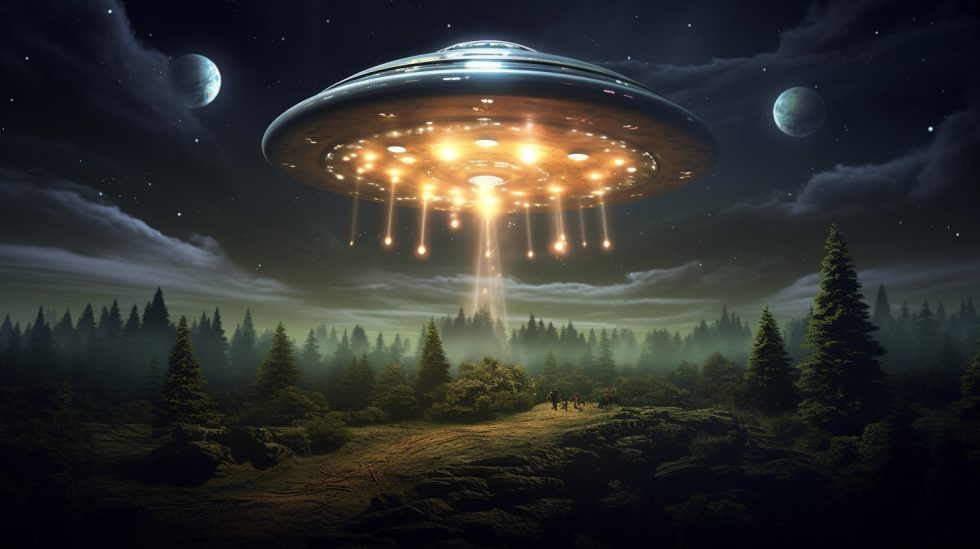
During the summer of 2023, a former U.S. intelligence official testified before Congress, claiming that the Pentagon possessed crashed alien craft and “non-human biologics.” His claims, though unverified, ignited a fresh wave of fascination. Social media lit up with talk about UFOs, or in official jargon, UAPs (Unidentified Aerial Phenomena). For some, this revelation (or rumor) isn’t just about extraterrestrial technology; it’s a hint at something deeper—perhaps a new spiritual frontier where alien contact replaces or reimagines old religious narratives. As we see viral stories of “mysterious orbs” and whistleblowers suggesting a cosmic cover-up, the question emerges: are we on the cusp of a spiritual transformation led by space visitors, or are we simply rehashing age-old hopes and fears about the unknown?
A Renewed Surge in UFO Talk
For decades, UFO sightings lurked on the edges of mainstream conversation, mostly relegated to tabloid fodder or sci-fi conventions. Then, in 2020, the U.S. Navy admitted certain leaked videos—showing fast-moving, tic-tac-shaped objects—were genuine “unidentified” phenomena. Suddenly, UFOs were no longer exclusively conspiracy chat. Major media outlets began covering them earnestly, culminating in congressional hearings. The official stance remains cautious: these sightings could be advanced foreign drones, atmospheric anomalies, or yes, maybe something not of this Earth.
This shift from fringe to quasi-legitimate interest reawakened the UFO community, which has long contended that governments know more than they admit. For UFO enthusiasts, each incremental disclosure confirms their belief that we’re not alone—and that a “disclosure event” is imminent. Yet the spiritual dimension, while less discussed in official channels, has quietly grown among those who interpret UFO sightings as cosmic revelations or spiritual signs.
Aliens as Modern Angels?
In the 1950s and ’60s, a wave of so-called “contactees” claimed benevolent aliens—often humanoid, sometimes shining with otherworldly light—visited them to deliver messages of peace and spiritual enlightenment. These beings were portrayed less like monsters from pulp fiction and more like advanced cosmic siblings. Some contactees formed UFO-based religious movements, blending biblical end-time ideas with interstellar prophecies. Indeed, groups like the Aetherius Society or Unarius Academy of Science see aliens as spiritually evolved guardians helping Earth ascend.
Contemporary UFO spirituality riffs on the same theme: that ETs might serve as angels or guides, pointing humankind toward cosmic unity. Many “experiencers” (people who believe they’ve encountered aliens) report messages about caring for the planet, evolving our consciousness, or transcending nuclear warfare. In that sense, UFO narratives can function like modern mythology, re-enchanting a disenchanted world with the promise of a bigger cosmic family.
Echoes of Miracle Sightings and Marian Apparitions
Sociologists note parallels between UFO sightings and historical religious phenomena—like Marian apparitions (the Virgin Mary appearing in visions) or local miracles. In each case, communities interpret unexplained events as signs of divine presence. People gather at “holy sites” or watch the skies, expecting further revelations. The difference, of course, is that UFO watchers frame the phenomenon in extraterrestrial terms rather than angelic or saintly ones. But the structure of belief is similar: an extraordinary sign, a mystical experience, a prophecy for humankind’s future.
Critics point out that humans have a tendency to project spiritual or mythic significance onto the unknown—be it comets in ancient times or blinking lights in the sky now. Perhaps we yearn for contact with something greater, whether we call it gods or aliens.
The Role of Fear and “Demonic” Narratives
Not everyone sees aliens as cosmic saviors. Some UFO-related movements emphasize abduction stories, medical experiments, or secret infiltration. They paint ETs as manipulative or even demonic forces. Certain conservative religious circles interpret UFO sightings as satanic deceptions, preparing a grand end-times hoax. This ironically mirrors the spiritual fervor of the “benevolent alien” camp but flips it: instead of angels, they see devils.
The UFO phenomenon thus becomes a spiritual battleground. Are aliens here to uplift us, or enslave us? Or, as the more skeptical might say, is the whole debate a reflection of our hopes and anxieties—angels vs. demons re-skinned for a spacefaring age?
The “Cosmic Spirituality” Movement
Some spiritual seekers embrace cosmic spirituality—the notion that the universe teems with advanced life, and Earth is on the brink of an evolutionary leap once we acknowledge our interstellar neighbors. They discuss Ascension or a Galactic Federation, weaving together channelings from supposed alien entities, new-age healing practices, and quantum mysticism. In these communities, UFO sightings are signs that these higher beings are gently nudging humanity to awaken.
This path can overlap with conspiracy subcultures claiming world governments have pacts with certain alien species or that a big “disclosure event” will soon shatter the old order. For believers, it’s not just about recognizing UFOs exist—it’s about a radical transformation of consciousness and governance, as though once the aliens come out of hiding, Earth’s spiritual ascension will follow.
Government Disclosure and Religious Reactions
A frequent question arises: if tomorrow, the government declared, “Yes, we have proof of extraterrestrials,” how would mainstream religions respond? Historically, the Vatican has hinted that the existence of extraterrestrial life wouldn’t necessarily contradict Catholic doctrine. Some Protestant theologians argue that God’s creation could be vast enough to include countless alien civilizations. Others fear it might destabilize faith, especially if alien revelations clash with scriptural accounts of salvation history.
But for many faithful, a broader cosmic perspective might expand rather than destroy their theology. They could see aliens as part of God’s creation, maybe with their own “Christ event.” In any case, official disclosure—if it ever comes—would spark a theological scramble: reinterpretation of biblical texts, debates on the soul’s nature, and possible integration of alien beings into the spiritual fold.
UFO Conventions: Secular Pilgrimages?
UFO gatherings and festivals often resemble spiritual pilgrimages. Enthusiasts trek to Roswell, Area 51, or the annual UFO Congress like pilgrims visiting Lourdes. They share testimonies, witness accounts, and “miracle” sightings, sometimes culminating in group sky watches. The atmosphere can be as devotional as a religious retreat—people seeking a transcendent experience or at least camaraderie with fellow believers. Vendors sell alien-themed crystals, energy alignments, or starseed readings. All these underscore that for many, the UFO phenomenon is as much about metaphysical longing as it is about curiosity over lights in the sky.
Scams, Sects, and Cultish Dangers
Whenever spiritual fervor meets mystery, cult-like dynamics or scams often follow. Some self-proclaimed UFO gurus claim exclusive knowledge gleaned from telepathic contact with “Arcturians” or “Pleiadians.” They might charge for private sessions or push doomsday timelines that keep shifting. Vulnerable followers sometimes invest life savings or sever ties with “non-believers.” These groups can mirror doomsday cults, except the promised apocalypse or salvation is tied to alien intervention.
We saw a tragic example with Heaven’s Gate in 1997, where members believed a UFO trailing the Hale-Bopp comet would ferry them to a higher existence. The movement ended in mass suicide. That extreme case highlights how UFO spirituality can turn lethal if combined with charismatic control and apocalyptic mindsets. So while cosmic beliefs can be enriching for some, they can also be exploited.
Beyond the Hype: Rational Curiosity or Spiritual Quest?
For many people, the UFO question remains primarily scientific or rational: Are these objects advanced drones, misidentified phenomena, or actual alien craft? But swirling around that are centuries of spiritual speculation. Are we alone? If not, what does that mean for our place in the cosmos? Even a confirmed microbe on Mars would raise theological queries about life’s uniqueness. Full-blown contact with an intelligent species could upend how we interpret creation stories, redemption, and the role of humankind.
Some scientists like Carl Sagan or Jill Tarter mused that discovering ET life would unite humanity under a cosmic perspective—leading to a kind of secular spirituality or “pale blue dot” humility. Others fear panic or chaos if official revelations confirm we’re being visited. Yet humans have always had frameworks—mythical or religious—to integrate the unknown. UFO spirituality is just the latest iteration, bridging the gap between cosmic wonder and existential longing.
Conclusion: A New Religious Frontier?
So, is alien contact truly our new spiritual frontier? Possibly. For those disillusioned with traditional faiths, the idea of higher cosmic beings can stand in for gods or angels—mighty, empathetic, and more scientifically plausible to modern minds. For devout believers, UFOs might expand or challenge their theology, prompting reexamination of dogmas about Earth’s centrality. For skeptics, it’s all a psychological or cultural phenomenon revealing how we project meaning onto unexplained lights.
In any case, the fervor around UFO sightings, whistleblower accounts, and congressional hearings isn’t just about “Where are the aliens?” It’s about grappling with the spiritual and philosophical fallout if we aren’t alone. Each new wave of UFO mania reaffirms that humanity, across time, thrives on cosmic mystery—whether we label them as gods from above or travelers from distant galaxies. We crave awe, guidance, and the sense of something bigger. If we do stand on the brink of contact, our spiritual narratives may morph yet again, weaving ETs into the tapestry of cosmic faith. Until then, the skies remain a canvas for our deepest yearnings—lights dancing on the edge of possibility.






Leave a Reply